GOP Governor Asks Voters to Raise Their Own Taxes
Michigan voters go to the polls today to vote on Proposal 1, a referendum that would hike the state sales and gasoline taxes. An unexpected twist in the story, though, is who is backing the plan and why. Support for the proposal speaks to the declining state of infrastructure in the U.S. and the increasing urgency with which states are taking matters into their own hands.
Proposal 1 is a complex mix of policy changes that would raise more than a billion dollars to fund road construction and repair, plus hundreds of millions for education and other purposes. It would do so by hiking the Michigan state sales tax from 6 percent to 7 percent. That represents a 17 percent increase in total sales taxes Michiganders will face on taxable items.
Related: America’s Energy Infrastructure in Desperate Shape
However, the bill also abolishes the sales tax on gasoline – Michigan is one of the few states in which gas is not exempt from state sales tax – and would dramatically increase the wholesale gasoline tax. The net effect, according to the Detroit Free Press, would be an increase of between 7 and 9 cents per gallon in what consumers pay at the pump. The proposal would net about $1.9 billion per year for the state’s coffers, the majority of it coming out of the pockets of Michigan’s taxpayers. (A small percentage would come from out-of-state visitors paying taxes on items purchased in Michigan.)
Normally, a $2 billion tax hike – the biggest in the state in a generation – would be the sort of thing Republican politicians would attack mercilessly, but in Michigan, Republican Governor Rick Snyder is a strong proponent of the deal. And Snyder isn’t alone. Prominent Republican and Democratic lawmakers have thrown their support behind the measure.
Related: Get Ready to Pay More Tolls If Infrastructure Isn’t Funded
The move also has significant support from the business community. Unsurprisingly, the biggest backers of the deal are the construction companies and related industries. But there is also support in the general business community, even among some companies whose products would be more expensive.
Even with substantial support from legislative leaders and businesses, though, the prospects for Proposal 1 looked poor heading into the vote today Public opinion remains generally against the proposition despite a multimillion-dollar advertising campaign by supporters that has dwarfed efforts by the opposition.
Should the vote fail, though, the state’s pothole-pocked roads and crumbling bridges won’t fix themselves, so legislators will have to find the revenue somewhere, either by increasing taxes via a different route, or cutting spending from an already tight state budget.
Stat of the Day: 0.2%
The New York Times’ Jim Tankersley tweets: “In order to raise enough revenue to start paying down the debt, Trump would need tariffs to be ~4% of GDP. They're currently 0.2%.”
Read Tankersley’s full breakdown of why tariffs won’t come close to eliminating the deficit or paying down the national debt here.
Number of the Day: 44%

The “short-term” health plans the Trump administration is promoting as low-cost alternatives to Obamacare aren’t bound by the Affordable Care Act’s requirement to spend a substantial majority of their premium revenues on medical care. UnitedHealth is the largest seller of short-term plans, according to Axios, which provided this interesting detail on just how profitable this type of insurance can be: “United’s short-term plans paid out 44% of their premium revenues last year for medical care. ACA plans have to pay out at least 80%.”
Number of the Day: 4,229
The Washington Post’s Fact Checkers on Wednesday updated their database of false and misleading claims made by President Trump: “As of day 558, he’s made 4,229 Trumpian claims — an increase of 978 in just two months.”
The tally, which works out to an average of almost 7.6 false or misleading claims a day, includes 432 problematics statements on trade and 336 claims on taxes. “Eighty-eight times, he has made the false assertion that he passed the biggest tax cut in U.S. history,” the Post says.
Number of the Day: $3 Billion
A new analysis by the Department of Health and Human Services finds that Medicare’s prescription drug program could have saved almost $3 billion in 2016 if pharmacies dispensed generic drugs instead of their brand-name counterparts, Axios reports. “But the savings total is inflated a bit, which HHS admits, because it doesn’t include rebates that brand-name drug makers give to [pharmacy benefit managers] and health plans — and PBMs are known to play games with generic drugs to juice their profits.”
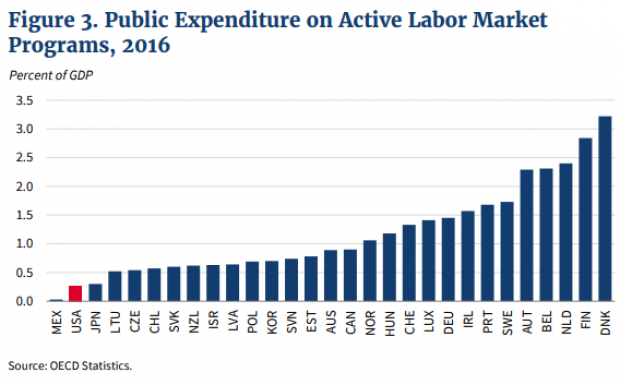
Chart of the Day: Public Spending on Job Programs
President Trump announced on Thursday the creation of a National Council for the American Worker, charged with developing “a national strategy for training and retraining workers for high-demand industries,” his daughter Ivanka wrote in The Wall Street Journal. A report from the president’s National Council on Economic Advisers earlier this week made it clear that the U.S. currently spends less public money on job programs than many other developed countries.