
Most Americans Think Our Morals Are Going To Hell
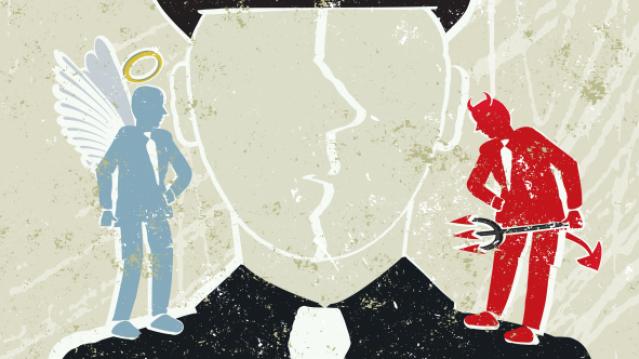
Ask anyone about the state of moral values in the U.S. and you’re likely to get a response along the lines of, “we’re going to hell.”
Most Americans — 72 percent — are convinced that moral values in the U.S. are decaying, according to a new Gallup poll, and most people believe the current state of moral values isn’t all that great to begin with. Nearly half of those polled, 45 percent, called the state of moral values in the U.S. “poor,” while 34 percent said they are “only fair.”
Just 19 percent rated American morals as either “excellent” or “good,” and only 22 percent say the state of moral values is getting better.
Unsurprisingly perhaps, social conservatives have consistently been most likely to tell pollsters that the nation’s moral values are deteriorating, but the latest Gallup findings showed an uptick from 2014 to 2015 among social moderates and social liberals who believe moral values are regressing.
Related: How U.S. Morals Stack Up Against the World
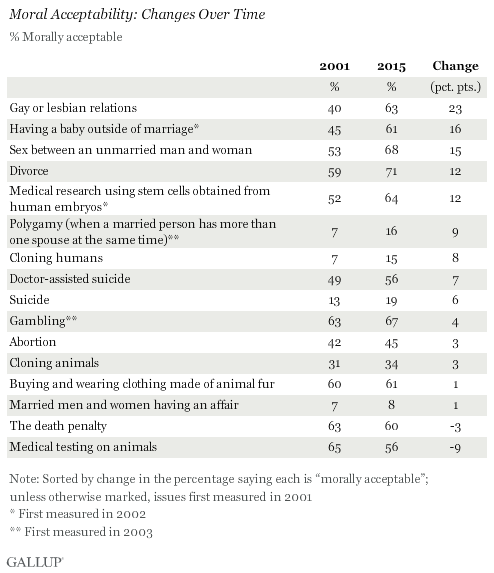
Gallup also found that Americans’ views of the moral acceptability of a number of key issues has been shifting to the left since 2001. The largest shift was on gay or lesbian relations, with a 23 percentage point increase in the share of people who say that behavior is morally acceptable. The change coincides with a sharp increase in support for same-sex marriage.
Sex between unmarried people has also become more acceptable, as has having babies outside of marriage. Polygamy and divorce are also now acceptable to a greater portion of the population than in 2001. On the other hand, the views of married men and women having an affair haven’t changed much, with just 8 percent of Americans saying it’s morally tolerable.
However, respondents to the poll about the current and future state of moral values weren’t necessarily responding with those charged social and political issues in mind. In many cases, Gallup suggests, their views of the moral direction of the country were rooted in something much more basic: “That is, their views have less to do with greater acceptance of same-sex marriage or having babies out of wedlock and other hot-button issues, and more to do with matters of basic civility and respect for each other,” Gallup’s Justin McCarthy wrote.
Clearly, the Golden Rule is still the bedrock of our moral code: Love thy neighbor as thyself.
Science Confirms: Watching Online Cat Videos Is Good for You
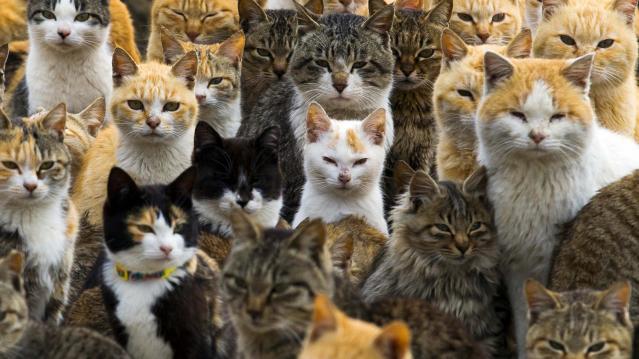
Looking at Grumpy Cat’s underbite and feline dwarfism just might just make you feel better about your bratty kid, your nagging spouse or your demanding boss. That’s right, according to a new study published in the journal Computers in Human Behavior, watching cat videos online reduces our negative feelings while raising our sense of well-being and boosting our energy levels.
Grumpy Cat, whose real pet name is Tardar Sauce, shares a manager with fellow YouTube stars Keyboard Cat and Nyan Cat. Last we checked, the famous feline had 7.7 million Likes on Facebook. In all, more than 2 million cat videos were posted on YouTube last year, gathering nearly 26 billion views. Cat videos had more views per video than any other category of YouTube content. That makes kittens more valuable eye candy than, say, Maxim’s Hot 100. (Taylor Swift topped the list this year, just in case you were wondering.)
Related: The Internet Power of Kim Kardashian’s Butt
For the new study, Jessica Gall Myrick, an assistant professor at the Indiana University Media School, surveyed nearly 7,000 Internet users about how watching cat videos affects their moods. She got a little help from Bloomington, Indiana resident Mike Bridavsky — the owner of Internet celebrity cat Lil Bub — who used social media to recruit participants for the survey.
The results should make you feel a bit less guilty about clicking through one cat video after another: “Even if they are watching cat videos on YouTube to procrastinate or while they should be working, the emotional pay-off may actually help people take on tough tasks afterward,” Myrick says.
Don’t think watching cat videos online is a pop culture phenomenon worthy of academic research? Myrick disagrees: “If we want to better understand the effects the Internet may have on us as individuals and on society, then researchers can’t ignore Internet cat videos anymore.”
Read the original paper on emotion regulation procrastination, and watching cat videos online here.
McDonald’s Slims Down in the U.S. for the First Time
For the first time in at least 45 years — and maybe the first time in its history — McDonald’s says that this year it will close more restaurants in the U.S. than it opens.
An Associated Press review of McDonald’s filings with the Securities and Exchange Commission found that the company hasn’t slimmed down the number of restaurants it operates in the U.S. since at least 1970. McDonald’s as we know it was founded in 1955 and grew quickly in its early years, making it likely that 2015 will be the first time it takes down more Golden Arches than it puts up in the U.S.
Related: Why Chipotle Wants to Give Its Workers More Than a McJob
McDonald’s does shutter underperforming locations every year, but up until now the number of closings has been outweighed by new openings. The world’s biggest hamburger chain has been struggling to grow sales as consumers turn to chains like Chipotle and Five Guys Burgers and Fries, which market themselves as serving better food and ingredients.
McDonald’s is still growing globally, though. It has about 36,000 locations across the globe and plans to expand that total by about 300 this year. In addition, the chain is still indisputably the country’s largest hamburger chain, with more than twice as many restaurants as its main rival, Burger King.
McDonald’s spokeswoman Becca Hary told the AP that relative to the roughly 14,300 U.S. locations, the net reduction in U.S. stores would be “minimal,” though she declined to give an exact number.
More Money Coming Out of 401(k)s Than In
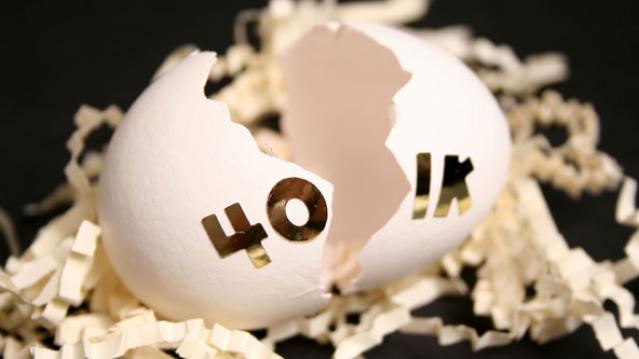
The amount of money withdrawn from 401(k) plans exceeded the amount contributed to the retirement funds for the first time in 2013, according to a report in The Wall Street Journal.
The shift reflects demographic changes as more Baby Boomer retire from the workforce and begin tapping their savings, and young millennial workers put smaller amounts in.
Consumers may benefit from the trend as fund managers begin cutting fees and changing services in order to entice young workers to sock away more. “It changes the dynamic of the business itself,” J.P. Morgan Chase analyst Ken Worthington told The Journal.
Related: Here Are 7 Ways People Screw Up Their 401(k)s
Company-sponsored 401(k) plans had $4.6 trillion in assets last year, according to the Investment Company Institute.
The average 401(k) balance at the end of the first quarter was $91,800, up 0.5 percent from the fourth quarter of 2014 and up 3.6 year-over-year, according to Fidelity. For employees in a plan for 10 years or more, the average balance was $251,600, up 12 percent year-over-year.
Workers can contribute up to $18,000 in pre-tax dollars to their 401(k) plans in 2015, but most workers—especially younger ones—save far less each year. There are lots of reasons millennials are lagging in retirement savings: large numbers of them are still unemployed or underemployed in jobs that don’t have retirement benefits, and they’re diverting all their extra cash to student loans. Plus, retirement may not be top-of-mind for 20-somethings, no matter how many times they hear about the benefits of compound interest.
Why a Woman Will be on the $10 Bill and Not the $20
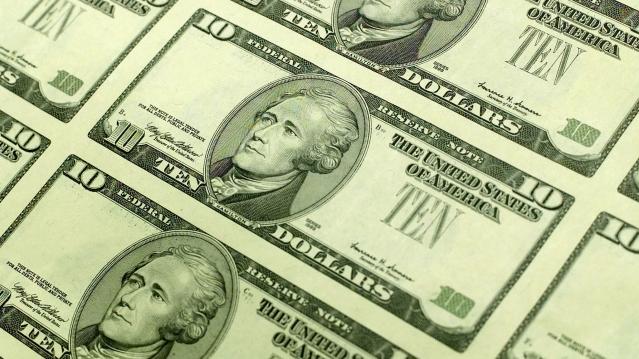
The announcement that the Bureau of Engraving and Printing will add a woman to the portrait of Alexander Hamilton on the $10 bill has stirred a lot of conversation as to why the Treasury was not redesigning the $20 bill instead.
It turns out there is a very simple explanation: The move is based on recommendations from the Advanced Counterfeit Deterrence (ACD) Steering Committee.
Related: The Best Bank in Every Region Across America
"Currency is redesigned to stay ahead of counterfeiting," the US Treasury says. "The ACD Steering Committee recommended a redesign of the $10 note next. The ACD will make its next recommendation based on current and potential security threats to currency notes."
The ACD bases those recommendations on the "current and potential security threats to currency notes," and it turns out that the $10 bill is at a greater threat of being counterfeit than the $20 bill.
Secretary of the Treasury Jack Lew announced the change in a statement on YouTube: "I'm proud to announce today that the new $10 bill will be the first bill in more than a century to feature the portrait of a woman.”
Hamilton will share the note with a woman who Lew is expected to choose by the end of the year. The new bill will enter circulation after 2020.
This article originally appeared on Business Insider.
Read more from Business Insider:
Fitbit opens up 52%
Why people are angry about the $10 bill change
The 'Tesla of scooters' is finally available and it looks incredible
FCC Slaps AT&T with $100 Million Fine for Throttling Internet Users
The FCC on Wednesday slapped AT&T hard, proposing a $100 million fine — the largest the agency has ever handed down — for what it described as the phone and broadband giant’s misleading customers about its “unlimited” data plans.
At issue is the practice of “throttling,” or limiting download and upload speeds for some users on those data plans.
Related: John Oliver Just Won the Net Neutrality Battle
AT&T’s throttling policy had been in place since 2011, according to an FCC statement, and it led to a barrage of complaints to the agency. AT&T targeted users who surpassed a certain data threshold over the course of a month, and consumer complaints argued that AT&T’s limiting of download speeds was directly at odds with the nature of the marketed “unlimited” plans.
AT&T, which is also pursuing government approval of its pending acquisition of DirecTV, says it will “vigorously dispute” the decision. In a statement, the company said that its practice is well documented and shared by many — if not all — service providers, and a legitimate method of managing their network’s resources. The FCC disagrees, claiming that AT&T violated transparency rules by falsely calling these plans unlimited.
"Broadband providers must be upfront and transparent about the services they provide,” said FCC Chair Tom Wheeler in a statement. “The FCC will not stand idly by while consumers are deceived by misleading marketing materials and insufficient disclosure."
Related: The Net Neutrality Debate Explained
AT&T has 30 days to respond before the FCC issues its final decision.
The Federal Trade Commission sued AT&T for $3.5 million in October last year, for the same alleged violation. That case is still ongoing.