
Can ‘Project Lightning’ Give Twitter a Fresh Jolt?
The ubiquitous blue bird associated with Twitter (TWTR) has been incessantly chirping out new announcements this month as the social media phenom tries to pick itself back up after being slammed for weak earnings growth and the underperformance of its stock.
Projections from data firm eMarketer call for the Twitter monthly user base to grow at a measly 14.1 percent this year, compared with more than 30 percent growth two years ago, according to Reuters.
While the news last week that CEO Dick Costolo was relinquishing the corner office was not a shock since he has offered to resign in the past, the appointment of co-founder and former chief executive Jack Dorsey as provisional CEO caused a stir in the business and tech worlds. Not only is Dorsey the CEO of his own mobile payments startup, Square, but he was reportedly removed from his role as CEO of Twitter in 2008.
The shakeup caused a brief spike in the company’s shares, but the stock is now back to where it had been before the announcement — and if it’s going to climb higher, investors may to need to see some other changes, too.
That’s where the slew of product announcements comes in. The latest, revealed yesterday on Buzzfeed, is called Project Lightning. Essentially, if there’s a hot topic that people are tweeting about — either prescheduled events, breaking news or ongoing events — Twitter has created an easy way for users to view the most popular and relevant tweets, images and videos, without having to sift through every tedious comment and retweet. Twitter will have a team of editors select the tweets they think will be most popular on the stories they see as the biggest of the moment.
The goal is to make Twitter easier to use and more engaging for an audience that isn’t necessarily interested in actively tweeting. (Twitter’s stock jumped more than 4 percent Friday in response to the new product announcement, its best day in months.) Similarly, Twitter is trying to bring down other obstacles to using its service. The same day the news was released about Costolo, Twitter also announced the removal of the 140-character limit on the direct messages feature. Getting rid of the limit is a step by the company to keep up with rival social networks and messaging apps, like Facebook and WhatsApp.
Related: Instagram Takes Steps to Open Platform to Advertisers
At the same time it tries to draw in users, Twitter executives know they must do more to attract advertisers. Six ad executives surveyed recently by Reuters said they spend more money on rival platforms because they have more users, better data to target consumers and create more effective ad content. To combat that perception, Twitter this week announced a push to bring in advertisers by rolling out video ads that will automatically play in a user’s timeline. Though initially muted, if a user clicks on the video it will switch to full-screen mode with sound. Advertisers will only be charged when a user has watched at least three seconds of the video on a full screen.
Both Facebook and Instagram offer an almost identical ad feature.
Which Would You Rather Have Stolen: Your Naked Photos or Your Financial Data?
Given the choice, more than half of Americans would prefer to have naked photos of themselves leaked online than have their financial information stolen, according to a new report by MasterCard.
The study finds that more than three-quarters of Americans are anxious about their financial information and social security numbers being stolen or compromised. That makes it a worry for more Americans than having their email hacked (62 percent) or their home robbed (59 percent).
Still, most Americans aren’t properly safeguarding their data. Although more than 90 percent of those surveyed said that they take precautions to protect their financial information, 46 percent rarely or never change their passwords, and 44 percent use the same password for multiple online accounts.
Related: Expert Tips to Reduce Your ID Theft Risk
The two post popular passwords found on the Internet last year were (once again) 123456 and “password,” according to a separate report by password management provider SplashData.
In addition to changing your password and using multiple, strong passwords for various accounts, consumers can protect their data by avoiding public WiFi for purchases and shopping online only on secure sites.
There’s good reason to be cautious. Last year, 2.5 times more consumers were notified that their personal information had been compromised in a data breach than in 2013, according to Javelin.
If you are worried that you have been the victim of ID theft, report it immediately to your credit card issuer, bank, and other financial institutions. Sign up for a fraud alert and check your credit reports regularly for suspicious activity.
One Woman Gets Revenge on Unrelenting Telemarketers
We all hate telemarketers, just as much as we hate cable companies. Put them together and it’s a lethal combination. One woman got her revenge from both yesterday when a judge ordered Time Warner Cable to pay her $229,500 after the company harassed her with 153 computer-controlled “robocalls.”
Even after Texas resident Araceli King requested and then demanded that the company stop contacting her, she received 74 more calls from Time Warner in less than a year. The company was actually leaving messages for Luiz Perez, an individual who once had her same phone number. But even after she explained her identity to a company representative the calls kept coming and King filed the lawsuit. The calls began in the summer of 2013 and King filed her lawsuit in March 2014.
Related: 18 Companies Americans Hate Dealing with Most
U.S. District Judge Alvin Hellerstein ruled that Time Warner Cable violated the Telephone Consumer Protection Act of 1991, which stipulates that consumers can sue for $500 for every unwanted call received. The judge tripled the penalty to $1,500 in this case because of the enormous number of calls.
Time Warner Cable countered that since the company believed it was calling Perez, who had consented to the calls, it was not responsible to King under the Act.
According to a telemarketer, before the National Do Not Call Registry came into effect in 2004 as an amendment to the Act, more than 137 annual calls were directed – on average -- at a single individual.
And as we all know, they usually came at dinner time or early on a Saturday morning when all you wanted to do was sleep.
One Woman’s $229,000 Revenge on Unrelenting Telemarketers
We all loathe telemarketers, probably even more than we hate cable companies. Put them together, though, and you reach a whole new level of consumer fustration. But one woman got a little bit of vindication from both entities when a judge on Wednesday ordered Time Warner Cable to pay $229,500 after the company harassed her with 153 computer-controlled “robocalls.”
Even after Texas resident Araceli King requested that the company stop contacting her, she received 74 more calls from Time Warner Cable in less than a year. The company was leaving messages for Luiz Perez, an individual who once had her same phone number, even after she explained her identity to a company representative and filed the lawsuit. The calls began in the summer of 2013 and King filed her lawsuit in March 2014.
Time Warner Cable countered that since the company believed it was calling Perez, who had consented to the calls, it was not responsible to King under the Telephone Consumer Protection Act of 1991, which stipulates that consumers can sue for $500 for every unwanted call received.
U.S. District Judge Alvin Hellerstein ruled that Time Warner Cable violated the Act. The judge tripled the penalty to $1,500 in this case because of the enormous number of calls.
The Hole Truth: Celebrating a Huge Day in Doughnut History

Whether you’re a Dunkin’ devotee or are crazy for Krispy Kremes, July 9 is a date you should celebrate.
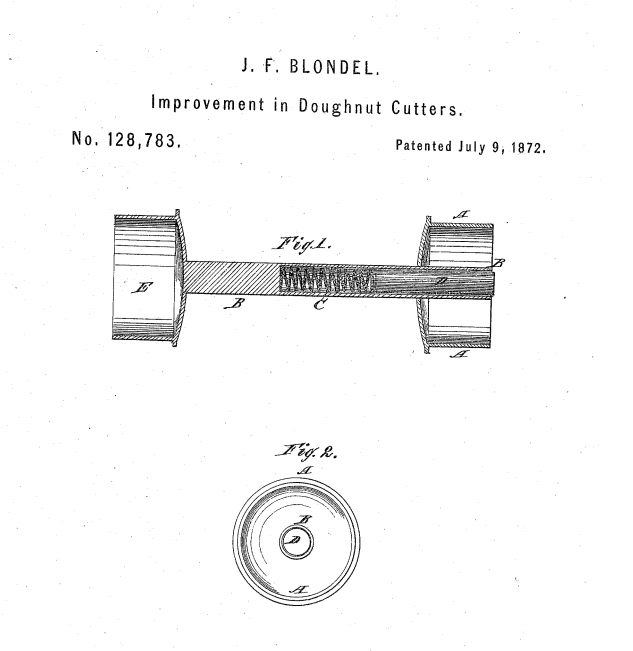
On that date back in 1872, the doughnut took a big step toward becoming the billion-dollar business it is today: John F. Blondel of Thomaston, Maine received a patent for a “new and useful” improvement in doughnut-cutters that would speed the production and consumption of the humble pastry in the United States.
The device described in Patent No. 128,783 was intended to automate the process of cutting those dastardly doughnuts — holes and all — as efficiently as a hole punch. The desired edge could be plain or scalloped. This ingenious contraption would push the dough out of the center tube, leaving it free for making the next doughnut.
Related: Made in the USA: 24 Iconic American Foods
But as Art Cashin — the director of floor operations for UBS Financial Services who regularly sprinkles historical tidbits into his commentary — pointed out in a note Wednesday, before you can talk about Blondel’s doughnut innovation, you have to know the story of one Hanson Crockett Gregory, the young genius who forever changed what you and I get when we order our plain, glazed or chocolate with sprinkles. While the history of the doughnut is disputed, Gregory claimed to have invented “the first doughnut hole ever seen by mortal eyes” as a 16-year-old sailor on a lime-trading ship and then taught the technique to his mother, Elizabeth Gregory.
In case you’re still hungry for more doughnut history, this Friday, July 10, Krispy Kreme is celebrating its 78th birthday by offering a sticky sweet deal at participating locations: Buy any dozen doughnuts at regular price and get a second dozen for 78 cents.
Oh, and if you want to purchase those pesky doughnut holes that get unceremoniously shoved from the middle? You can buy those, too. They’re simply called Doughnut Holes, and they can be bought by cup or box in assorted flavors of Original Glazed, Dipped Chocolate, Powdered, Chocolate Cake, Blueberry Cake and Plain Glazed Cake.
Hanson Crockett Gregory would no doubt be amazed.
Are Internet Ads Gender Biased?
In the most-watched soccer game in U.S. history, the U.S. trounced Japan in a 5-2 victory in the Women’s World Cup final. The U.S. team will receive $2 million from FIFA for the win. Last year, the German men’s team, which won the World Cup, collected a cool $35 million.
While FIFA is notorious for sexism among other dubious behaviors, a Carnegie Mellon University study confirms that other companies are also biased about women—especially when it comes to money. One troubling example: female job seekers on Google were less likely to be shown ads for high paying jobs than male job seekers.
Using an automated tool called AdFisher, researchers explored how Google’s automated ad server reacted when users with identical profiles--except for their gender--interacted with Google’s ads. The technology found that males were shown ads for a career coaching service for “$200k+” executive positions 1852 times, but the female group was shown those highly paid positions a mere 318 times. While the premier career coaching service ads were the top ads shown to males, the top ads shown to females were a regular job posting service and an auto dealer.
Google allows its advertisers to target a particular audience, so any company is allowed to promote different ads based on gender. In addition, the survey wasn’t able to pinpoint the source of the discrimination, whether it was Google, the advertiser, both of them, or the algorithm that was tracking the user behavior. Regardless of the cause, the research proves the inherent perils of customization and targeted ads.
The study was released just before a wave of criticism hit the tech industry, which was accused of gender bias in hiring practices. In general, at major companies like Facebook, Yahoo and Google, women hold few leadership posts and make up around 30 percent of employees.
To be fair, women have not exactly flocked to get degrees in computer science and related math and science areas. Those are the jobs tech companies value most since all new digital products require coding skills.