
Did Kasich Just Do an About-Face on Climate Change?
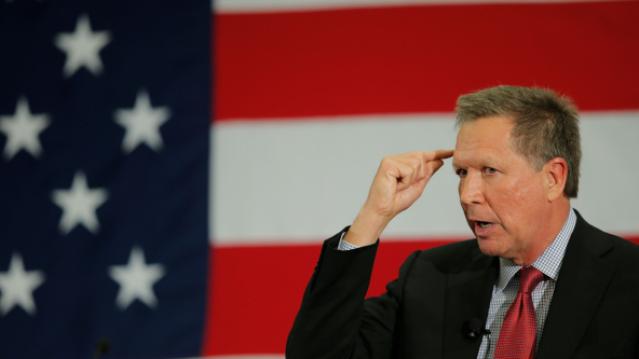
Maybe it’s because he is still feeling his way as a late entrant into the GOP presidential campaign, but Ohio Gov. John Kasich did a fairly dramatic about-face over the weekend on the politically charged issue of climate change.
Kasich, a former House Budget Committee chair and Wall Street business executive, has positioned himself as a “kinder, gentler” conservative than Jeb Bush, Ted Cruz and the dozen other Republicans running for the 2016 presidential nomination. So it wasn’t surprising that he would take a more moderate stand on global warming during the first nationally televised GOP presidential debate Thursday evening.
Related: 10 Things You Need to Know About John Kasich
Kasich, a devout Christian, declared during the two-hour debate sponsored by Fox News that climate change is a real problem requiring government and society to protect the “creation that the Lord has given us.”
While the vast majority of Republicans on Capitol Hill and the campaign trail are highly skeptical of President Obama’s campaign to curb industrial carbon emissions to prevent the disastrous long term effects of global warming on the environment and economy, Kasich appeared to be one of the few who took the threat seriously.
He emphasized the importance of unity and cooperation, saying at one point that “we’ve got to unite our country again, because we’re stronger when we are united and we are weaker when we are divided.”
Just a few days later, though, after winning plaudits for his Thursday night performance – with some even favorably comparing his views on environmental threats to those of Pope Francis – Kasich sounded much like a climate-change doubter.
Related: Does Kasich Have a Chance? How He Can Catch Up to the GOP
During an appearance on NBC News’ “Meet the Press,” Kasich told moderator Chuck Todd that “I think man absolutely affects the environment, but as to whether, you know, what the impact is, the overall impact, I think that’s a legitimate debate.”
Kasich went on to say that in Ohio, “we preciously take care of Lake Erie, and we’ve reduced emissions by 30 percent over the last ten years.”
“We believe in alternative energy,” he added. “So of course we have to be sensitive to it, but we don’t want to destroy people’s jobs, based on some theory that’s not proven.”
According to National Journal, the Kasich 2016 campaign attempted to clarify his remarks following his appearance on “Meet the Press.” "The governor has long believed climate change is real and we need to do something about it,” according to the statement. “The debate over exact percentages of why it is happening is less important than what can be done about it. We know it is real, we know man has an impact, and we know we need to do something."
A number of prominent presidential candidates -- including former Florida governor Jeb Bush and Sens. Ted Cruz, Marco Rubio, and Rand Paul -- are climate change doubters or deniers. Sen. Lindsey Graham of South Carolina is one of the few who unquestionably accepts scientific evidence that man-made greenhouse gas emissions are a principal cause of global warming, and has sharply criticized his party for lacking a comprehensive environmental platform.
Top Reads From The Fiscal Times:
- How GOP Candidates Would Steer U.S. Foreign Policy
- Fiorina Takes on Trump in a Brave Battle of the Sexes
- As Politicians Bicker Over Funding, Military Families Cut Back on Vacations
Can Anyone Stop the $38 Billion Airline Fee Squeeze?
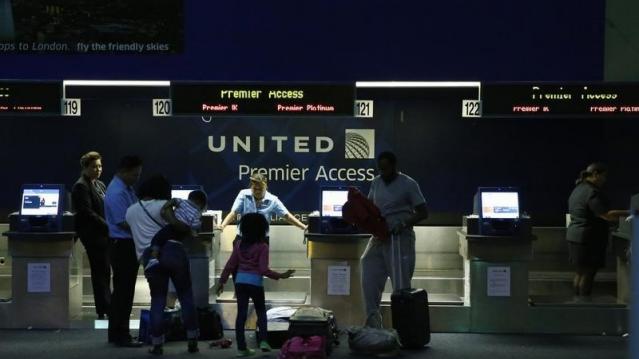
U.S. airlines earned $2.6 billion in fees and frequent flier mile sales in 2014, an 18.7 percent increase from 2013, according to an annual report by consultancies IdeaWorks and CarTrawler.
That represents the eighth consecutive year that carriers saw substantial revenue ancillary to ticket sales. Globally, ancillary revenue soared more than 20 percent to $38.1 billion.
“Ancillary revenue is an increasingly important indicator of commercial success, and a major contributor to the bottom line of airlines across the globe,” said Michael Cunningham, CarTrawler’s Chief Commercial Officer, in a statement.
Related: 6 Sneaky Fees that Are Making Airlines a Bundle
By passenger, additional revenue grew by 8.5 percent to $17.49. Low cost carriers increased ancillary revenue by 32.8 percent for the year, or $2.9 billion.
Ten airlines earned two-thirds of the ancillary revenue, led by United Airlines, American/U.S. Airways, and Delta. Delta brought in $350 million through its Comfort Plus program, which allows passengers to pay extra for more legroom and priority boarding.
Among passengers’ most hated fees are checked bag fees. Airlines typically charge $25 for the first bag, $35 for the second, and more than $100 for a third bag.
As frequent fliers turn to branded credit cards as a means of avoiding fees, airlines are still earning money. Last year, American’s Citibank-issued credit card, which gives consumers one free checked bag and priority boarding, yielded an additional $624 million for the carrier last year.
The additional fees are not improving the customer experience. More than 60 percent of consumers surveyed by the U.S. Travel Association in March said they were frustrated with air travel generally.
Memo to Michelle Obama: Americans Still Aren’t Eating Their Greens

Maybe First Lady Michelle Obama should refocus her healthy eating campaign more on adults than children. Fewer than 20 percent of American adults are eating enough fruits and vegetables, newly released data from a Centers for Disease Control and Prevention survey.
The United States Department of Agriculture’s nutrition guidelines recommend that Americans have two to three cups of vegetables every day, along with 1.5 to two cups of fruit. Based on those criteria, only 13 percent of adults in the survey ate enough fruit and a meager 9 percent of individuals ate enough vegetables. These numbers are worse than in years past. Between 2007 and 2010, 76 percent of Americans didn’t consume the recommended amount of fruit and 87 percent failed to eat enough vegetables.
Related Link: The 11 Worst Fast Food Restaurants in America
What’s more, while consumption of fruits and vegetables varies substantially from place to place, the residents of each and every state in the union fell short of the USDA recommendations. In Tennessee, 7.5 percent of residents consume enough fruit, while in Mississippi, a mere 5.5 percent of individuals eat enough vegetables. California ranked highest for eating both fruits and vegetables, but even there, just about 18 percent eat enough fruit and 13 percent eat enough veggies.
“Substantial new efforts are needed to build consumer demand for fruits and vegetables through competitive pricing, placement, and promotion in child care, schools, grocery stores, communities, and worksites,” the CDC report says.
The report comes out after a study published in last month’s JAMA Internal Medicine found that fewer than one-third of Americans are currently at a healthy weight. The majority of individuals are either overweight or obese.
Diane von Furstenberg Will Sell a Purse that Charges Your Phone
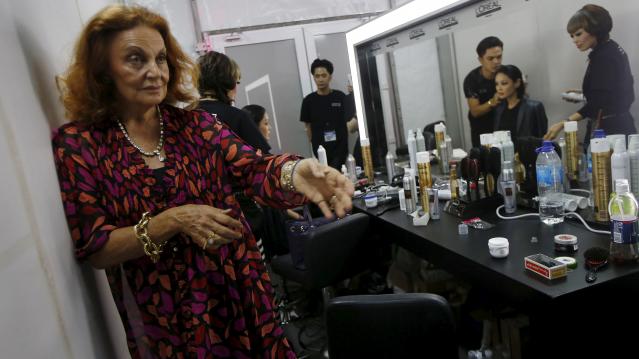
Fashion mogul Diane von Furstenberg said she will launch a high-tech purse that automatically—and cordlessly—charges smartphones.
The purse, which does not yet have a price tag, will go on sale in limited edition this holiday season, before rolling out broadly next year. The designer is working with an undisclosed technology partner on the handbag.
"My role in fashion is really solution driven," von Furstenberg said. "I'm always on the go, so [it's important] you have everything at the right time."
The idea of creating a handbag that charges a smartphone isn't entirely new. Kate Spade recently announced that it will launch a similar product line this fall.
Related: 16 Must-Have Products to Make Your Home Smarter Right Now
Von Furstenberg, a regular in Sun Valley, Idaho, took the stage at this year's Allen & Co. conference for a panel on the future of fashion, along with Spanx founder Sara Blakely.
She's there to meet with technology companies as she works to bring fashion into the future.
"Technology is the biggest revolution," von Furstenberg said. "It's such a big part of our lives, we do everything with technology, so it's not even separate anymore. It just is."
Related: 10 Biggest Tech Flops of the Century
Though she doesn't wear an Apple Watch, the designer said she's also interested in wearable technology. At her New York Fashion Week show in September 2012, she sent models down the runway wearing Google Glass.
But von Furstenberg cautions the term "wearable tech" will soon become obsolete.
"Wearable technology won't even be a word anymore, because everything you do will have technology," she said.
Von Furstenberg added that technology isn't just important for the future of fashion products—it's already crucial to their marketing.
"If you're interested in millennials, everyone is on social media and everyone is a brand," she said. "It's very interesting to brands to see how they can work with a generation, who each of them is [their own] brand."
This article originally appeared on CNBC.
Read more from CNBC:
For an airline upgrade, miles aren't the best
How movie theaters are striking back against Netflix
14 retailers shaking up the industry
Corporate Sponsors Pass on Women's World Cup Ticker-Tape Parade
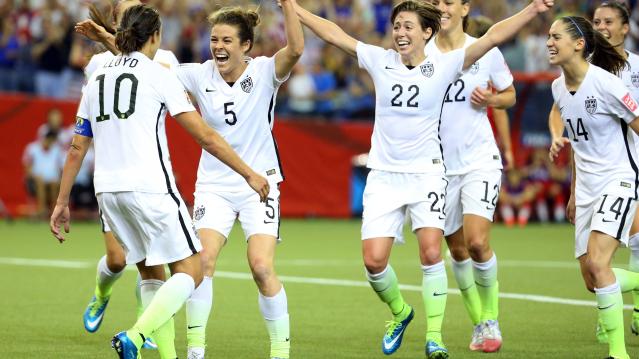
While the country celebrates the U.S. Women’s Soccer team’s World Cup Championship with a New York City ticker tape parade, corporations have been reluctant to pony up cash to cover the $2 million celebration.
Major League Soccer, Nike, fod company Mondelez and video game giant Electronic Arts have contributed a total $450,000 toward the parade, leaving New York City to cover the difference, the New York Post reports. That includes the cost of cleanup and security.
By contrast, the 2012 parade that celebrated the New York Giants winning the Super Bowl had more than a dozen corporate sponsors.
Related: For World Cup Hero Carli Lloyd, 16 Minutes Can Mean Millions
City officials told the Post that the dearth of sponsors reflected the short period of time in which the city pulled together plans for the parade. The team is the first women’s squad to receive a New York City ticker tape parade, although the city has honored individual women, such as Olympic athletes and Amelia Earhart.
More than 12,000 people entered a lottery for tickets to the parade, which will feature the team atop patriotic floats moving down the Canyon of Heroes in lower Manhattan as spectators throw confetti from surrounding buildings.
While companies may not have shown much interest in the parade, they are clearly interested in star Carli Lloyd. Her agent has repeatedly received more than 200 inquiries from marketers who want to work with the athlete.
That’s good news for Lloyd, who like all other National Women’s Soccer League players, is subject to a $37,800 salary cap, about one 10th of what the average male Major League Soccer player makes in a year.
Corporate Sponsors Didn't Kick in Much for Women's World Cup Parade

While the country celebrates the U.S. Women’s Soccer team’s World Cup Championship with a New York City ticker tape parade, corporations have been reluctant to pony up cash to cover the $2 million celebration.
Major League Soccer, Nike, fod company Mondelez and video game giant Electronic Arts have contributed a total $450,000 toward the parade, leaving New York City to cover the difference, the New York Post reports. That includes the cost of cleanup and security.
By contrast, the 2012 parade that celebrated the New York Giants winning the Super Bowl had more than a dozen corporate sponsors.
Related: For World Cup Hero Carli Lloyd, 16 Minutes Can Mean Millions
City officials told the Post that the dearth of sponsors reflected the short period of time in which the city pulled together plans for the parade. The team is the first women’s squad to receive a New York City ticker tape parade, although the city has honored individual women, such as Olympic athletes and Amelia Earhart.
More than 12,000 people entered a lottery for tickets to the parade, which will feature the team atop patriotic floats moving down the Canyon of Heroes in lower Manhattan as spectators throw confetti from surrounding buildings.
While companies may not have shown much interest in the parade, they are clearly interested in star Carli Lloyd. Her agent has repeatedly received more than 200 inquiries from marketers who want to work with the athlete.
That’s good news for Lloyd, who like all other National Women’s Soccer League players, is subject to a $37,800 salary cap, about one 10th of what the average male Major League Soccer player makes in a year.