
Americans Just Went on a $32 Billion Credit Card Shopping Spree

Americans may be heading for another credit card crunch. After paying down almost $35 billion in credit card debt in the first quarter of the year, consumer charged up a storm in the second quarter, racking up $32.1 billion in new debt, according to CardHub, a credit card comparison site. CardHub says that’s the second highest quarterly total since it began keeping data on credit card debt in 2009.
While that buying binge could potentially signal improved confidence in the economy and in their own financial prospects, CardHub warns that the debt risks are building. It projects that consumers will close out the year with an annual net increase of more than $60 billion in credit card debt, with the total credit card debt outstanding climbing to more than $900 billion, the highest since the recession.
Related: 5 Cities with the Most Credit Card Debt
CardHub CEO Odysseas Papadimitriou says that jump brings Americans “perilously close to a tipping point at which balances become unsustainable and delinquency rates skyrocket.”
For 7 out of the past 10 quarters, consumers have racked up more debt than they’ve paid off. Papadimitriou cites that as evidence that consumers are going back to the bad habits they had before the economic downturn.

CardHub based its study on data from the Federal Reserve, and if the results are a sign of trouble then another new report from the Federal Reserve Bank of New York suggests that problem is even worse than it looks. In a report called “Do We Know What We Owe,” the New York Fed found that people widely underestimate their credit card debt, telling the Fed’s survey-takers that it’s about 37 percent lower than what lenders say it is.
So if we are actually getting to a tipping point with credit card debt, it may be even closer than we realize.
Top Reads From The Fiscal Times
- Millions Facing a Hefty Increase in Medicare Premiums in 2016
- How Much Does Our Social Safety Net Cost? $742 Billion a Year and Rising
- The 10 Worst States for Property Taxes
Budget ‘Chaos’ Threatens Army Reset: Retired General
One thing is standing in the way of a major ongoing effort to reset the U.S. Army, writes Carter Ham, a retired four-star general who’s now president and CEO of the Association of the U.S. Army, at Defense One. “The problem is the Washington, D.C., budget quagmire.”
The issue is more than just a matter of funding levels. “What hurts more is the erratic, unreliable and downright harmful federal budget process,” which has forced the Army to plan based on stopgap “continuing resolutions” instead of approved budgets for nine straight fiscal years. “A slowdown in combat-related training, production delays in new weapons, and a postponement of increases in Army troop levels are among the immediate impacts of operating under this ill-named continuing resolution. It’s not continuous and it certainly doesn’t display resolve.”
Pentagon Pushes for Faster F-35 Cost Cuts

The Pentagon has taken over cost-cutting efforts for the F-35 program, which has been plagued by years of cost overruns, production delays and technical problems. The Defense Department rejected a cost-saving plan proposed by contractors including principal manufacturer Lockheed Martin as being too slow to produce substantial savings. Instead, it gave Lockheed a $60 million contract “to pursue further efficiency measures, with more oversight of how the money was spent,” The Wall Street Journal’s Doug Cameron reports. F-35 program leaders “say they want more of the cost-saving effort directed at smaller suppliers that haven’t been pressured enough.” The Pentagon plans to cut the price of the F-35A model used by the Air Force from a recent $94.6 million each to around $80 million by 2020. Overall, the price of developing the F-35 has climbed above $400 billion, with the total program cost now projected at $1.53 trillion. (Wall Street Journal, CNBC)

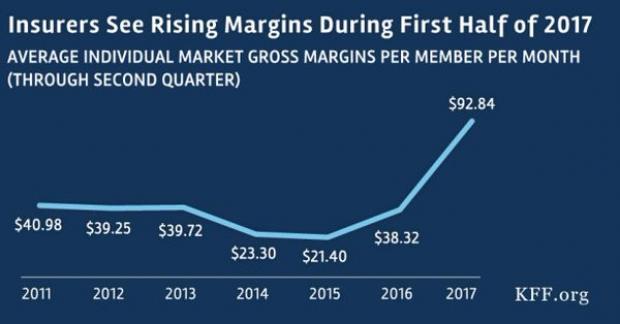
Chart of the Day - October 6, 2017
Financial performance for insurers in the individual Obamacare markets is improving, driven by higher premiums and slower growth in claims. This suggests that the market is stabilizing. (Kaiser Family Foundation)
Quote of the Day - October 5, 2017
"The train's left the station, and if you're a budget hawk, you were left at the station." -- Rep. Mark Sanford, R-S.C.