
GOP Governor Asks Voters to Raise Their Own Taxes
Michigan voters go to the polls today to vote on Proposal 1, a referendum that would hike the state sales and gasoline taxes. An unexpected twist in the story, though, is who is backing the plan and why. Support for the proposal speaks to the declining state of infrastructure in the U.S. and the increasing urgency with which states are taking matters into their own hands.
Proposal 1 is a complex mix of policy changes that would raise more than a billion dollars to fund road construction and repair, plus hundreds of millions for education and other purposes. It would do so by hiking the Michigan state sales tax from 6 percent to 7 percent. That represents a 17 percent increase in total sales taxes Michiganders will face on taxable items.
Related: America’s Energy Infrastructure in Desperate Shape
However, the bill also abolishes the sales tax on gasoline – Michigan is one of the few states in which gas is not exempt from state sales tax – and would dramatically increase the wholesale gasoline tax. The net effect, according to the Detroit Free Press, would be an increase of between 7 and 9 cents per gallon in what consumers pay at the pump. The proposal would net about $1.9 billion per year for the state’s coffers, the majority of it coming out of the pockets of Michigan’s taxpayers. (A small percentage would come from out-of-state visitors paying taxes on items purchased in Michigan.)
Normally, a $2 billion tax hike – the biggest in the state in a generation – would be the sort of thing Republican politicians would attack mercilessly, but in Michigan, Republican Governor Rick Snyder is a strong proponent of the deal. And Snyder isn’t alone. Prominent Republican and Democratic lawmakers have thrown their support behind the measure.
Related: Get Ready to Pay More Tolls If Infrastructure Isn’t Funded
The move also has significant support from the business community. Unsurprisingly, the biggest backers of the deal are the construction companies and related industries. But there is also support in the general business community, even among some companies whose products would be more expensive.
Even with substantial support from legislative leaders and businesses, though, the prospects for Proposal 1 looked poor heading into the vote today Public opinion remains generally against the proposition despite a multimillion-dollar advertising campaign by supporters that has dwarfed efforts by the opposition.
Should the vote fail, though, the state’s pothole-pocked roads and crumbling bridges won’t fix themselves, so legislators will have to find the revenue somewhere, either by increasing taxes via a different route, or cutting spending from an already tight state budget.
This Is What America’s 'Dream Home' Looks Like

The dream home for today’s American consumer is just over 2,000 square feet and located outside of a major city, according to a report out today by Trulia.
Consumers polled by the real estate Web site said the top features in their dream home were a backyard deck, a gourmet kitchen, and an open floorplan.
Owning a home is still part of the American dream for 70 percent of those polled, down from 77 percent five years ago. The portion of Americans who want to buy a home one day was highest—hitting almost 90 percent—among millennials.
Related: 10 Luxury Home Amenities that Are Trending Up
Those findings echo the results of a Wells Fargo poll in June, which found that nearly two-thirds of consumers say that home ownership is a “dream come true” and an accomplishment to be proud of.
Despite the desire for home ownership, only 14 percent of those surveyed by Trulia said they would buy a home this year. Nearly 70 percent said they planned on waiting at least two years to make a purchase.
The country’s home ownership rate fell to 63.7 percent in the first quarter, the lowest level since 1989. The rate peaked at 69.2 percent in the fourth quarter of 2004, right before the housing bubble burst.
Just 36 percent of millennials who want to buy a home are currently saving to purchase one. As rents in many cities continue to skyrocket, however, homeownership may become more appealing.
- The 10 Fastest-Growing Jobs Right Now
- Teens Are Having Much Less Sex Than Their Parents Did at That Age
- 9 Social Security Tips You Need to Know Right Now
CVS Quit Selling Cigarettes, but It’s Found a Patch for Sales
CVS executives knew that some of their sales would go up in smoke when they decided last year to stop selling cigarettes. The press release announcing that all 7,600 CVS stores nationwide would stop selling all tobacco products acknowledged that sales would take a hit. Still, the company said, “This is the right thing to do.”
The costs of the decision are now becoming clear. CVS Health’s general merchandise sales slumped 7.8 percent last quarter on a same-store basis, the company said Tuesday. The company claims non-pharmacy sales would have stayed the same if tobacco sales — and the other products cigarette buyers added to their baskets — were removed from sales figures for the same quarter in 2014.
Related: Why Smoking Is Even Worse Than We Thought
Same-store sales in the pharmacy category climbed 4.1 percent, boosting overall same-store sales growth to 0.5 percent compared with the second quarter of last year, down from a 1.2 percent year-over-year increase the previous quarter. Net revenue overall grew by 7.4 percent to $37.2 billion, helped by pharmacy services revenue that surged 11.9 percent ($2.6 billion) to $24.4 billion. The company has reportedly increased its market share in the health and beauty categories (it did, however, narrow its full-year earnings forecast).
So even as the move to drop cigarettes has cost the company, its bet on health as the source of future growth may be starting to pay off. CVS stock dropped in the wake of its earnings announcement, but shares are still up more than 15 percent on the year and 44 percent over the past 12 months.
Is the American Dream Dead? Most Parents Think Their Kids Will Be Less Well Off

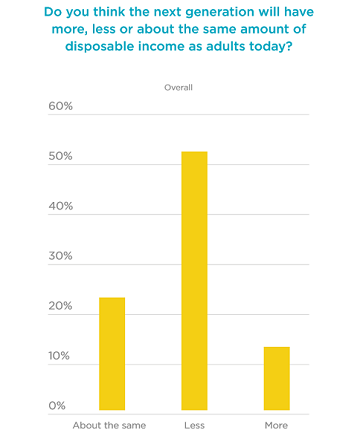
Parents think their children will be happier and healthier in the future as adults, but also less well off, according to a new report commissioned by insurance company Haven Life.
Only one in eight Americans believe that their children will be better off financially, when compared to their parents. More than half of American parents believe their children will have less disposable income in the future, and only one in five Americans believe their children will enjoy greater quality of life.
Related: Should You Leave Your Home to Your Kids?
On the other hand, more than 60 percent of adults believe that future generations will lead “as healthy or healthier” lifestyles than adults today. And half of them think their children will grow up to be more environmentally conscious adults who lead greener lifestyles. More than half believe that this future generation will be more ethnically and racially diverse.
The study was done by YouGov for the Haven Life Insurance Agency. YouGov conducted an online poll with a representative sample of 1,124 U.S. adults in the first quarter of 2015.
Top Reads from The Fiscal Times
- The 10 Fastest-Growing Jobs Right Now
- Teens Are Having Much Less Sex Than Their Parents Did at That Age
- 9 Social Security Tips You Need to Know Right Now
Travel Nightmares: How to Avoid Getting Bumped from Your Flight
You're finally on your way out for a summer vacation. The flight was booked months ago. Your bags are packed and ready. You arrive at the airport the recommended 90 minutes before the scheduled departure time (because it's a great long trip, and you've decided to check your bags). After enduring the inhumanity that is the TSA line, you get to your gate. Of course, everyone else has done the same thing, and you hear the familiar strains of "this flight is overbooked, we are offering a travel voucher if you are willing to fly on a later flight."
But you ignore that, as always, because, well, your bags are already on the plane, and you don't want to miss even a second of your long-awaited time away. Still, that $300 voucher sounds tempting. You could use it to help defray the cost of holiday travel in a few months.
Don't do it. Resisting that temptation can be even more rewarding: If the worst still happens and you get involuntarily bumped, you can get a full refund of your ticket price plus up to $1,300 in added compensation.
The AirHelp inforgraphic below lays out the basic dos and don'ts of dealing with an overbookd flight. You can also find more from AirHelp here.

(h/t lifehacker.com)
Blame China for Your Costly Lobster Roll

Looking for authentic, down-home Maine lobster? Head to China.
The upsurge in demand for lobster in China this year has caused the price of the succulent marine crustacean to shoot up to record highs in the U.S., according to Bloomberg News. Wholesale prices for lobsters have clawed 32 percent higher over the last year.
Lacking a lobster industry itself, China used to rely on Australian imports to meet the demand from an expanding middle class that views lobster as a status symbol. But in 2012, as catches off of Western Australia began dwindling and prices of lobster fell in the Gulf of Maine, China changed its main supplier to the U.S.
Related: McDonald’s Aims for a Classier Crowd with Lobster Rolls
Lobster exports from the East Coast are the main reason for the hike in fish and seafood exports to China in recent years, according to U.S. Department of Agriculture data. Over the past seven months, about 60,000 live North American lobsters a week make the 7,500-mile trek halfway across the world. The lobsters must still be alive by the time they arrive in China or else they lack appeal, so they’re packed in wet newspapers and Styrofoam coolers for a trip that must be made in 18 hours or less, according to Bloomberg.
Another reason for the surge in prices was the bitterly cold winter this year, which slowed the catch in Canada and delayed the summer harvest in Maine.
Holding off on your lobster roll until next summer in the hopes that prices will wane? Don’t count on it. The Chinese middle class is still growing rapidly, and the country already consumes 35 percent of the world’s seafood — a number likely to increase.
Top Reads from The Fiscal Times:
- Born in the USA: 24 Iconic American Foods
- America’s 10 Top Selling Medications
- You’re Richer Than You Think. Really.