
GOP Governor Asks Voters to Raise Their Own Taxes
Michigan voters go to the polls today to vote on Proposal 1, a referendum that would hike the state sales and gasoline taxes. An unexpected twist in the story, though, is who is backing the plan and why. Support for the proposal speaks to the declining state of infrastructure in the U.S. and the increasing urgency with which states are taking matters into their own hands.
Proposal 1 is a complex mix of policy changes that would raise more than a billion dollars to fund road construction and repair, plus hundreds of millions for education and other purposes. It would do so by hiking the Michigan state sales tax from 6 percent to 7 percent. That represents a 17 percent increase in total sales taxes Michiganders will face on taxable items.
Related: America’s Energy Infrastructure in Desperate Shape
However, the bill also abolishes the sales tax on gasoline – Michigan is one of the few states in which gas is not exempt from state sales tax – and would dramatically increase the wholesale gasoline tax. The net effect, according to the Detroit Free Press, would be an increase of between 7 and 9 cents per gallon in what consumers pay at the pump. The proposal would net about $1.9 billion per year for the state’s coffers, the majority of it coming out of the pockets of Michigan’s taxpayers. (A small percentage would come from out-of-state visitors paying taxes on items purchased in Michigan.)
Normally, a $2 billion tax hike – the biggest in the state in a generation – would be the sort of thing Republican politicians would attack mercilessly, but in Michigan, Republican Governor Rick Snyder is a strong proponent of the deal. And Snyder isn’t alone. Prominent Republican and Democratic lawmakers have thrown their support behind the measure.
Related: Get Ready to Pay More Tolls If Infrastructure Isn’t Funded
The move also has significant support from the business community. Unsurprisingly, the biggest backers of the deal are the construction companies and related industries. But there is also support in the general business community, even among some companies whose products would be more expensive.
Even with substantial support from legislative leaders and businesses, though, the prospects for Proposal 1 looked poor heading into the vote today Public opinion remains generally against the proposition despite a multimillion-dollar advertising campaign by supporters that has dwarfed efforts by the opposition.
Should the vote fail, though, the state’s pothole-pocked roads and crumbling bridges won’t fix themselves, so legislators will have to find the revenue somewhere, either by increasing taxes via a different route, or cutting spending from an already tight state budget.
Obama’s Approval Tanks Over the Economy and ISIS
For a while, President Obama enjoyed a revival in popularity after years of public unease and displeasure with his stewardship of the economy and foreign policy. His approval rating jumped as high as 49 percent in mid-January, according to Gallup, and then tapered off a little amid renewed uncertainty about the economic recovery.
In the latest Washington Post/ABC News poll, however, 45 percent of Americans say they approve of Obama’s job performance, while 49 percent disapprove. That is his weakest rating in the survey since late 2014. The president effectively lost five points in approval since January and he hasn’t seen majority support since May 2013, according to survey analysis.
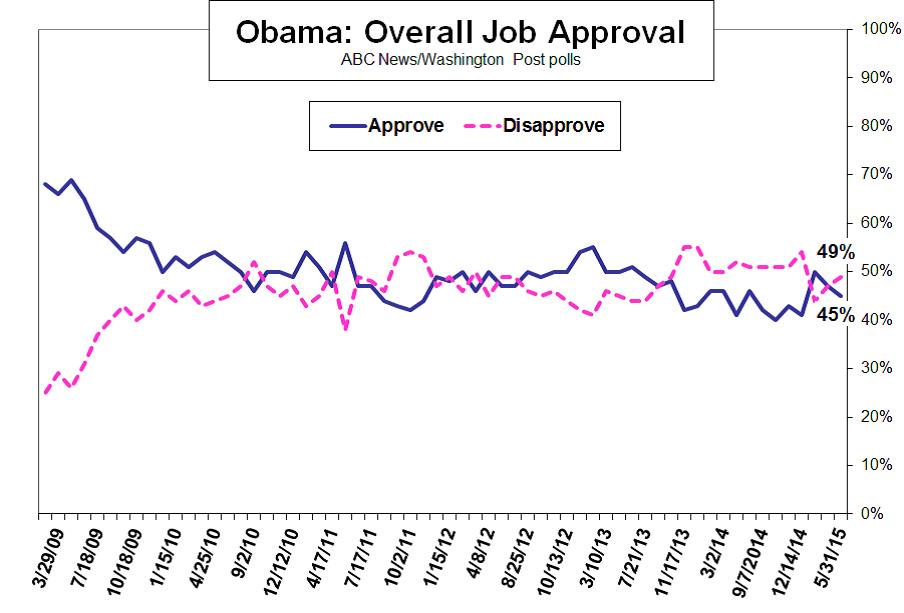
Analysts blame the decline in the president’s approval on continued economic anxiety at home – despite a drop in the unemployment rate to 5.4 percent in April and other signs of economic revival – and the advance of ISIS and other Islamic extremists in Iraq and Syria.
The condition of the economy consistently has topped the list of voters’ concerns heading into the 2016 campaign. The economic gains touted by the administration since the end of the Great Recession in June 2009 apparently haven’t been enough to calm fears, analysts say.
Seventy-three percent of those surveyed recently remain worried about the economy’s direction, and among them Obama’s approval drops to 35 percent, according to the survey. What’s more, Obama gets only a 31 percent approval rating specifically for handling the advance of ISIS militants, with 55 percent disapproving. Public approval of the president’s handling of the war against ISIS is 16 percentage points worse than his rating on handling the economy.
3 Dumb Moves That Can Hurt Your Career
What's the most common way to breach workplace etiquette and curb your career growth, if not derail it altogether?
AccountTemps says employers and staffers don't always see office etiquette the same. But bosses certainly have more leverage in the matter, since they can fire employees who buck the rules, and a company survey finds U.S. chief financial officers are most often bugged by workers "being distracted" on the job (27% of CFOs say so) and "gossiping about colleagues" (18%).
Other top offenses cited by CFOs:
- Not responding to calls or emails.
- Being late to meetings, or missing them.
- Not crediting other staffers when appropriate.
Employers and workers may not see the top etiquette breaches equally, but they agree on professional decorum more than they disagree, and the shared message is easy to sum up: "Most jobs today require teamwork and strong collaboration skills, and that means following the unwritten rules of office protocol," says Bill Driscoll, a district president of Accountemps. "Poor workplace etiquette demonstrates a lack of consideration for coworkers."
Related: Modern Etiquette: Outclassing the Competition
Of course, the list of workplace professional breaches exceeds the AccountTemps list.
"I've seen it all," notes Nicole Williams, a workplace consultant and a career contributor to NBC's The Today Show. "Employees who lie on expense reports; who badmouth the company or boss on social media or to clients; proofreading mistakes; missing deadlines. Just to name a few."
If you do trip up on the job, it's best to be accountable. "If you really screw up, you have to suffer the consequences in silence," Williams says. "Don't protest, don't try and get out of it, and don't put the blame on someone or something else. People will respect you more for owning your mistakes."
This article originally appeared on Main Street
Read More from Main Street
- 10 Ways to Blow a Job Interview
- The 10 Worst Cities to Enjoy a Summer 'Staycation'
- 12 Universities with the Biggest Endowments
Read more from Main Street: - See more at: http://www.thefiscaltimes.com/2015/05/19/Why-Even-Rich-Millennials-Are-F...
The Lucrative Business of SAT Test Prep Is About to Get Disrupted
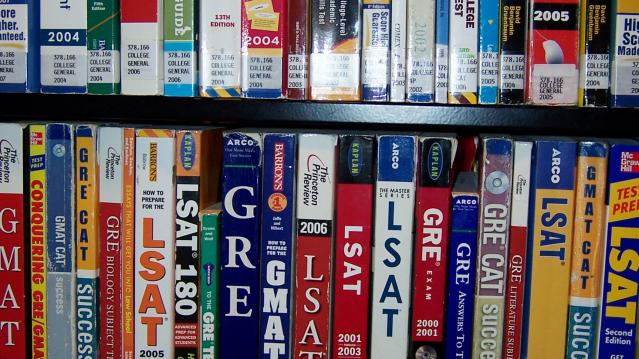
For years, critics of the SAT have claimed that wealthy students who can afford expensive, private test prep courses have a leg up on poorer students without access to such classes.
That just changed. Starting yesterday, all students can access free, high-quality online test prep via a new partnership between the College Board, which administers the test, and online course powerhouse Khan Academy, a nonprofit supported by the Bill and Melinda Gates Foundation and Ann and John Doerr among others. The online program will include quizzes, video lessons and personalized lessons.
The Official SAT Practice will focus on the recently redesigned SAT, with questions created by the tests’ authors.
Related: SAT Tests: Another Drain on the Family Budget
College test preparation is a $4.5 billion business. Private SAT tutors charge in excess of $100 per hour and classes from companies like Kaplan or Princeton Review run about $1,000. And those classes may help. Students from the wealthiest families have average test scores that are more than 300 points higher than students from the poorest families on average, according to the College Board.
In recent years, more colleges have moved away from the SAT and its competitor, the ACT, as a backlash against the tests have grown.
More than 850 schools have made the tests optional for admission, according to advocacy group FairTest, choosing instead to focus on class grades and other factors. A study released last year of undergrads at those schools found no difference in either the GPAs or the graduation rates of students who took the SATs versus those that skipped it.
Gas Prices This Summer Could Be Cheapest Since 2009
Gas prices have been on a tear in recent weeks, hitting a national average this week of $2.75 per gallon, the highest price this year, but they’re poised to fall back down as the summer progresses, according to AAA.
The organization is predicting that the cost of gas could fall to its lowest levels since 2009, which is good news for travelers ready to hit the road. About 60 percent of Americans recently surveyed by AAA said they were more likely to take a long road trip this year is gas prices remain low.
While the national average price of gas remains well below $3 per gallon, and 87 percent of U.S. stations are selling gas for below that benchmark, consumers out west and in Hawaii are paying more. Prices in California are highest at $3.30, followed by Hawaii ($3.70) and Nevada ($3.30).
Related: Gas Prices or Economy, Experts Disagree on What Drives U.S. Demand
The average price for a gallon of gas last month was $2.69 per gallon, nearly a dollar less than the $3.66 it cost last May. Economists have been hoping for months that low energy prices would boost consumer spending, but Americans have been choosing to sock away their extra cash rather than spending it.
Personal spending was basically flat in April, falling less than 0.1 percent despite a slight increase in personal income. At the same time, the savings rate increased from 5.2 to 5.6 percent.
Millennial Women are Taking Charge—at Work and at Home

According to a recent report from U.S. Trust, women at the top of the earnings ladder are not only making strides in the workplace, but they’re also taking charge of their households’ finances at higher rates.
The national survey of 640 adults found that among high-net-worth individuals—defined as those with at least $3 million in investable assets—30% of Gen Y women are breadwinners in their households, and another 21% contribute the same amount of income to the household as their partners.
Perhaps even more surprising? That’s true for Millennial women more than any other demo.
Related: How Millennials Could Damage the U.S. Economy
Compare that to the 11% of Gen X women and 15% of Baby Boomer women who earned more than their husbands.
Likely a result, young women have a greater influence over their family’s money decisions than ever. Among today’s high-earning female Millennials, 31% are the primary decision-makers when it comes to their household’s wealth and investment planning. That’s considerably more than the 11% of Gen Xers and 9% of Boomer women who can say the same.
Of course, these role changes don’t just affect women. As moms continue to earn more, about one in four Millennial fathers are more likely to be the primary caretakers of their children—a striking difference from the 7% of Gen X and 3% of Boomer dads who’ve undertaken the same responsibility.